
I Review AI Girlfriend Apps. Now I Talk to the People Who Build Them.
What I've learned from developers, how my feedback has helped improve their apps, and why my testing remains independent.
 Researched & written by Ranji Mercado · The Coach, aigirlfriend.coach
Tap for more +Tap to close ×
Ranji Mercado · content writer & data researcher
I run every page on this site the same way: experience first, write second. I subscribe with my own money, live in each app, log the dates, prices and screenshots, and only then write. Nothing here is a rewrite of someone else's article or a press kit.
When I started AI Girlfriend Coach, I figured I'd hear from the people who build these apps eventually. Review enough of them and someone on the inside is going to notice. I just didn't expect it this soon.
Over the past few months I've traded emails with developers, founders and support teams behind more than half of the 29 apps I've reviewed, and I've sat on a call with a founder.
I assumed those conversations would be about partnerships and reach. Most of them turned into something more valuable. Developers explained decisions I couldn't see from inside the app. They told me what's hard about running one. They asked what I thought about features they were still weighing. They answered the problems I found, and sometimes they changed the product after I reported them.
That's good for you too. When a bug gets fixed, the next person who signs up never runs into it.
So here's what I've learned from the people who build these apps, what's changed in their products after my feedback, and why none of it changes how I review.
What a founder told me about free tiers
I can tell you what happened when I used an app. I can't always tell you why. That second part is what these conversations are good for.
The one that surprised me most came on a call. Some apps give you five or six free messages before the paywall, and I've said in reviews that it isn't enough to judge anything. On that call, a founder was explaining why their free tier is so limited.
The answer wasn't what I expected. A lot of people look for ways around the free tier. They create several accounts just to keep talking to the same character. They use up the free image generations, then open another account to get more. I had never thought about how much effort some people put into that.
From my side, a tiny free tier looked like one thing: a push toward checkout. From theirs, it's also a response to people who keep opening new accounts to get more.
That didn't change what I write. If five or six messages isn't enough to judge an app, I'll still say so, because that's what you'll run into. I just understand one of the reasons the limit is there, and I think it's worth you knowing it too.
And limits do move. HeyGF's founder let me know the free daily limit had doubled from 15 messages to 30, and that went into the review as a dated update.
I saw a paywall. The founder saw people opening a fifth account.
Why paying is the hard part for them too
Checkout is where I've had the most trouble as a tester. I've paid for three apps with crypto, and it wasn't fun. I used to read a crypto-only checkout as a choice the app had made.
Two founders have since told me nearly the same thing: crypto wasn't what they wanted. They wanted card payments, and getting a card processor to accept an adult app was the hard part. One of them said most of their crypto checkouts were opened and never paid. So the checkout that annoyed me wasn't working well for them either.
That's a bigger story, and I'm writing it up separately.
The other payment detail I'd never thought about is the name on your card statement. One founder asked what I thought about changing the name that shows up on a bank statement to something more discreet. They were weighing privacy against the risk that people wouldn't recognize the charge and would dispute it. I said I'd keep the real name. Another app went the other way and switched to a quieter one.
I write down the statement name in my reviews, because you should know what will show up on yours. I'd only ever seen it as a line on my statement. For them it's a decision, and there's a trade-off on both sides of it.
What else the people building these apps know that my testing can't show me
Here are two more, both things I only know because someone on the inside told me.
- Why my messages vanished. On AmorLink, earlier messages kept disappearing from my chats, and I wrote that down. After the review went live, the founder explained it. Nothing was deleted. Reopening a chat only loaded the latest 10 messages. That also explained something I couldn't: why Irina still remembered my trip when the messages about it were gone from my screen. They called it a real bug and said they'd fix it.
- Why the replies are so long. I told one team their replies ran too long for me. They said most of their users choose the long, immersive role-play style, so it stays the default, and the short mode is there for people like me. I still prefer short. But now I know it's a choice they made, and who they made it for.
The AmorLink one shows why this is useful. I'd documented two things that didn't fit together: messages disappearing, and a companion who remembered them anyway. Testing gave me the puzzle. The founder gave me the answer.
When something I report gets fixed
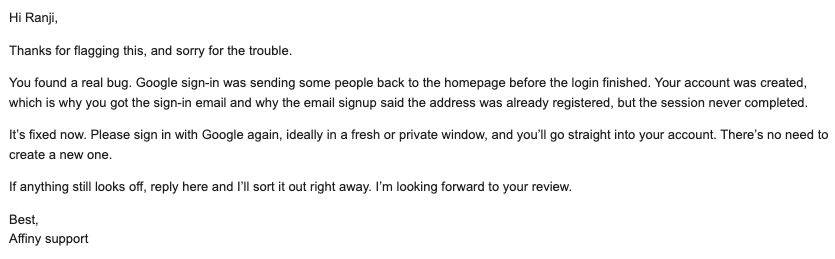
This is my favorite kind of reply. On Affiny, signing in with Google kept sending me back to the homepage, still logged out. I reported it. Support wrote back the next day that I'd found a real bug, and that it was fixed.
It's happened a few times now.
- EroLove. The payment page told me my payment had expired while my USDT was still on its way. Three days after my review went live, the team sent me a list of what they'd changed, starting with that page. They also said guest messages no longer eat into the five free ones you get when you sign up.
- NaughtyChats. The day after my review, the team told me they'd already changed several things I'd flagged, including a switch between short and long replies. Later they told me card checkout was live on the site, which was my biggest complaint.
Notice how I'm wording those: the team told me. Until I go back and test it myself, a fix is their word, not my finding. And I can't claim every change happened because of me. These teams hear from other testers and from their own users too.
Some of this starts with how I follow up. Once a review is live, I send the team the link and ask them to tell me if I got a fact wrong. Sometimes I also send a private feedback memo: what I think they should protect, and the issues I ran into, in priority order. Not every team gets one. I write it when a founder is open to it.
How do I feel when a fix happens? I think about it from the user's side. Say there's a problem at sign-up, and it gets fixed after I report it. The next person who signs up never runs into it. They'll never know there was a problem, or that a review had anything to do with it. That's fine. In a small way I still helped them.
Why a fixed bug stays in the review
This one took me a while to work out. The first few times a team told me they'd fixed something, my instinct was that taking it out was only fair. They changed it. If I tested again, I wouldn't hit it.
Then I realized what I'd be doing. My reviews document what I actually experienced, on the date I experienced it. Deleting a problem because it was fixed later would mean rewriting my own experience. That's why every review here is a living review with a dated timeline, and why there's an updates page.
So when one team asked me to remove a section about a bug they'd fixed, or else mark it as fixed, I went with marking it. Another asked me to look again at some section headings that weren't very favorable. I understand why. Headings are what people skim. But they describe what happened.
Here's what I do change:
- Errors on my end. If I got a fact wrong, I fix it as fast as I can. My corrections page explains how.
- Things that are out of date. A new price, a new limit, a new feature. Those go in as dated updates, once I've checked them.
- Features I missed. One team sent me a list of things I hadn't covered. That's fair, and useful. I go back and try them, and I write what I find.
- Privacy. A founder once asked me to take their name out of a review. I did it the same day. A person's name isn't one of my findings.
Do I feel pressured? Not to change a verdict. What I feel is closer to urgency. When a team writes to me about a review, especially the first time we talk, I move it to the top of my list, because if the mistake is mine I want it gone quickly.
I'll be honest about one more thing: I'm behind. A few teams have told me about fixes that aren't in their reviews yet, because I haven't retested them. They will be.
A fix gets added. It doesn't erase what came before it.
Has a developer ever changed my mind about their app?
Not really. Most replies I get are about what they improved, or a problem they fixed after I pointed it out. The rest is them explaining their decisions. Nobody has really tried to argue me into liking a product more.
And it wouldn't work the way they'd hope. If a founder tells me their memory is the best thing about the app, I don't write that down. I run the 7-day memory test and write down what happened.
What a developer tells me adds context to my experience. It doesn't replace it.
How These Collaborations Work
Some of these conversations start with me. Since mid-August I've been writing to apps to say I'm about to review them. Others start when a team finds one of my articles and writes to me first. That's how NaughtyChats, EroLove, Hayati, Sultrai and LoviDream ended up on my roster.
Sometimes I ask a team whether they'd share my review with their audience, usually by featuring or linking to it on their own blog or site. My work reaches people who are already interested in the product, and their users get a detailed review from someone who actually paid for it and tested it. Some teams have done that. Some agreed and never did, and their reviews say exactly what they'd say anyway. Several asked me to link to their app from the review. That's reasonable, a review should point at the thing it reviews, so I added it. For one app, I wrote a guest article for their blog. Nearly every conversation also comes with an affiliate offer, usually 40 to 50 percent of whatever a referred user pays. As I write this there still isn't a single affiliate link on the site. When that changes, my affiliate disclosure covers how it works.
Here's the part you should know. More apps write to me now than I can test, so an app whose team agrees to share the review tends to get tested sooner. That can change the order of my queue. It doesn't change what I write.
None of this gives anyone a say in my conclusions. I still buy my own subscription, document what happens, and publish it whether it's favorable or not. Nobody reads a review before it goes live. Developers can correct a fact, explain how their product works, and tell me when something's been fixed, which I then try to verify by testing it again. What they can't do is change my verdict in exchange for sharing my work. All of that is in my editorial policy, so you can hold me to it.
What I've been asked for, and what I said
Most teams just say yes and leave the review alone. A few have asked for more, and I think that comes from a fair assumption: that a review site's format is up for negotiation. On a lot of sites it probably is. These are the times I said no.
- First place. One team agreed to feature my review on two conditions: a link back from my review, and the number one spot in any list I publish. I told them I couldn't promise first place to anything that hadn't earned it in testing, and that I'd review them either way. They were fine with that. The review went up, and we've worked together since.
- A score. Another team liked their review and asked me to add a score from 1 to 5, so they could show it on their site next to my logo. I don't score apps with numbers. I describe what happened and let you judge. A score would change how I review every app, not just theirs, so I told them that.
- A free account. Most teams offer me a free account, or free credits. Seven have so far. I've paid every time, and it isn't to be difficult. Checkout is part of the test, and I can't tell you what paying is like if I never paid. One developer suggested I buy the top tier for three months. I bought the regular monthly plan, the same as I do everywhere, because that's what most people would buy.
- More mentions. One team asked me to mention their app in a few more places on my site, including my page of the best AI girlfriend apps. Where an app shows up here depends on how it tested.
I do value having my work shared with more readers. But each of these would have changed how I review, so I explained how I work instead.
What these conversations have taught me
A few months of this has changed how I look at the apps, even where it hasn't changed what I write about them.
- A limit usually has a reason. The free tier that frustrated me is partly there because of people opening account after account. I still report the limit. Now I can sometimes tell you why it exists.
- Checkout problems aren't always the app's choice. Two founders wanted card payments and couldn't get them. That doesn't make crypto easier for you, but it tells you where the problem actually sits.
- A default is a decision made for someone. Long replies, a quiet statement name. I may not be the user they chose it for, and that's worth saying in a review.
- Teams fix things quickly when you tell them. Affiny replied the next day. NaughtyChats wrote the day after my review, and EroLove three days after theirs.
- I hear about changes early. When something I flagged gets fixed, I'm often the first to know. When a feature ships, I hear about that too, and I can go and check it properly.
Developers can help me understand their apps. My testing can help them make those apps better. Neither of those changes who decides what goes in the review.
What I'd like this to look like a year from now
Founder interviews. I think you'd want to know who's behind the app you're talking to every night. One founder has already said yes. I'll send the questions by email and publish the answers as their own article.
Early looks at new features. That would be nice. I'd still pay for the plan.
Deeper testing, as a service. What I can offer developers is more of what I already do: longer tests and more detailed product feedback. That's work a team can hire me for. It buys the work and nothing else, and if it ever touches something I publish here, I'll say so on the page.
A study, done together. This is the one I'm most curious about. Developers can see what I can't: which features people use the most and what they actually prefer. I'd love to work with a few of them on a proper study of user preferences. My survey asked people what they think. This would show what they actually do.
One thing won't be on that list, however close these relationships get. I may earn from affiliate links, but I won't ask a developer to sponsor a review or cover a subscription. Paying for everything myself is the whole basis of this site.
What's next: testing AI girlfriends for an entire year
There's one thing I've been wanting to do for a while now.
Most of my reviews so far have involved testing an app for a week or several weeks, sometimes extending to a full month. That's enough time to learn quite a lot about its features, pricing, conversation quality, and even how well it remembers something after seven days.
But I've always wondered what happens beyond that.
What happens after three months of talking to the same AI girlfriend? Six months? An entire year?
Does she still remember the things you told her when you first met? Does her personality actually develop? Does the relationship feel any different, or do the conversations eventually become repetitive?
I'm planning to find out.
My next project is to buy annual subscriptions to around five to ten AI girlfriend apps and test them over an entire year.
Just like my existing reviews, I'll pay for the subscriptions myself. I'll keep documenting what happens, including the good experiences, the problems, and the changes developers make along the way.
The difference is that this time, I won't be stopping after a week or a month.
I want to find out whether these apps can deliver on their promises of memory, personality, and companionship when someone actually sticks around.
I'm still deciding which apps will make the list, but I'm looking forward to sharing what I discover.
A seven-day memory test tells me what an AI girlfriend remembers after a week. I'm curious what she'll remember after a year.